

Photo courtesy of http://liberato.org Ricardo Liberato
I recently saw yet another documentary on building the pyramids. Once again, it was all about the age-old question of how they got all those blocks up there. It’s been a favorite subject of archaeologist and crackpot alike since the return of the scholars who went to Egypt with Napoleon’s army in 1798.
These notes are about how implausible most of the last couple of hundred years of theories are, and how strange is the persistence of variations on the same clearly impossible idea, given that simple solutions that would actually work are fairly obvious.
A more plausible way is presented here.
The Problem
The Great Pyramid of Cheops, like the others, is mostly made of stone blocks roughly the size of refrigerators and the weight of a Cadillac Escalade. A few of the special purpose blocks weigh as much as 80 tons, but the bulk of the pyramid consists of blocks of about 2.5 tons. Each course is about the height of a dining table and there are something like 2.3 million blocks.
How did the ancient Egyptians get them up there without machinery? The hard-core obsessed also fret about how they got the big ones manhandled into place, and about how they got the massive pyramidal cap-stone up there with nowhere to stand, etc., but the canonical question is ever how they got all the little stones up there. An adequate solution to the problem of moving all the little blocks needs to also allow for how the giant blocks and the capstone got up there.
The solution presented here provides a solution to both of those problems as a side benefit.
The Problem
The image you still see the most often is of thousands of guys in diapers dragging the blocks on rollers up a two-kilometer earthen ramp. I don’t think anyone takes this seriously anymore.
Cheops is about 150 meters tall, which is 210 courses of blocks. The first problem is that a 150 meter high earthen ramp would bulk larger than the pyramid itself. It’s a crazy amount of dirt to move around even if you could engineer a pile of dirt strong enough to move that kind of weight on, which is extremely doubtful.
Another problem is that for the higher layers, the ramp would have to be wider than the narrowing pyramid itself in order to bear the pounding of workers dragging hundreds of thousands of tons of stone over it. This means that the ramp would have to more or less bury the pyramid.
So earthen ramps are out.
On the positive side, the majority of the mass in a pyramid is near the bottom, so the average block is not as high up as one might guess. With 210 layers, half the blocks are below the 53 layer, and 80% are below the 70th layer, just one third of the way up.
According to Euclid, the center of mass of a pyramid is h/4 above the base, so the average block is only going to ascend 1/4 of the height of the pyramid. Nevertheless, a ramp would still have to go at least near to the top, and even the top 1% of the pyramid volume amounts to 25,000 blocks.
The fundamental problem is time, not the difficulty of moving a block. The project took about 23 years and the number of blocks in the pyramid divided by the number of work-days and daylight hours, etc. works out to raising a block to its final resting place every 90 seconds, all day, every day, for the duration. That would rival the rate at which a modern container-port with multiple specialized cranes and thousands of trucks can empty a container ship.
Our crude figure of 90 seconds per block is actually extremely optimistic because big sections of the work, such as building the foundation, cladding the structure, tearing down and hauling away the hypothetical ramp at the end, etc. had to come either before or after the stacking phase. It also assumes nonstop traffic, that is, that teams don’t rest on the way up, ropes never break, and they never have to stop traffic to raise the ramp or do maintenance, etc. Another inconvenience is that a single ramp also forces you to complete as you go up because you can only get off at the top.
It’s not a plan.
Modern Solutions
More up-to-date proposed solutions dispense with the huge earthen ramp by winding the ramp around the pyramid, or building switchback ramps that lean against the pyramid. There’s another variant that has the winding ramp inside the pyramid. These ideas eliminate the giant earthen ramp that wouldn’t work anyway, replacing it with a more economical narrow ramp that is partly supported by the building. The problem is, they don’t address the bottleneck.

You can check out some of the many variants of the ramp scheme here: Building the Great Pyramid
Variants of the idea aren’t very promising either. For instance, you could use use multiple earthen ramps for the lower portion, and save the winding single ramp for the upper layers. But there are more than a million blocks higher than 37 meters, which is already extraordinarily high for anything made of earth.
Packed dirt isn’t very strong. You can’t build a narrow pile of packed earth that high because it won’t bear its own static weight, let alone many tons of moving stone, men, and draft animals. Mud-brick is considerably stronger, but the tallest mud-brick structures in the world are not much more than 30 meters high, and few are as much as even 15. Moreover, you can be sure that the owners of 30-meter mud brick buildings don’t allow grand pianos on the top floor.
An Easier Way
The model pictured below is based on a different principle.
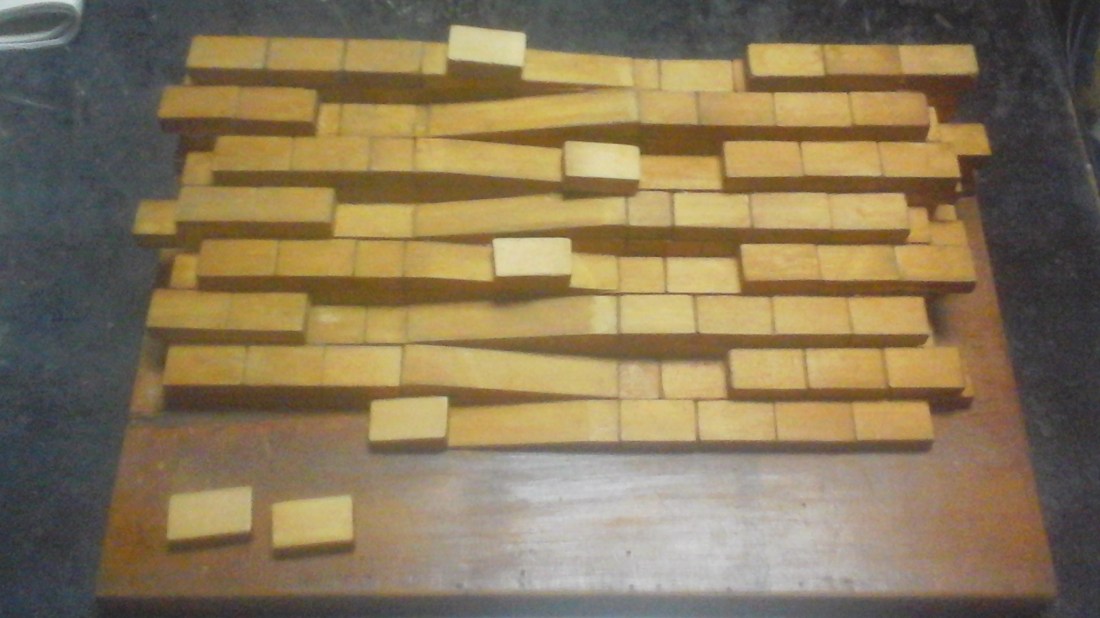
This proposed method uses each layer of the pyramid as a base for a short ramp that is the height of a single layer of stone, abut 75cm. A block is dragged up the greased ramp then levered sideways the width of a ramp to put it in position to dragged up the next ramp.
The ramps would be made of wooden timbers, and each block would be strapped to a low sled like a shipping pallet. Grease would ease the sled’s slide up the ramp.
We take it as a given that it is not difficult to construct wooden ramps of adequate strength. Today, you would knock one together out of dimension lumber from the big box store.
The issues open to question are
- Is it practical to drag stones weighing two or three tons up such ramps, and how would it be done?
- Is it feasible to raise 2.5 million blocks to their ultimate destinations within the required time?
Dragging Stone Up The Ramps
The ramps pictured in the model have a 1:10 slope. In practice, builders would use whatever slope experience shows optimizes the efforts of the workers. 1:10 might be a little shallow. The block only has to rise 0.75 meters, which is about thigh-high on an adult.
The ramps modeled here would be about 10 or 11 meters long, plus a few more feet of flat area at each end.
A grown man could easily drag 68 kilos up a forty-foot ramp. 68 kilos is the weight of a two-sheet bundle of 5/8″ sheetrock, and such bundles are routinely carried away by a single worker when unloading a truck. (I know because in my youth I unloaded I don’t know how many tons of them.)
If 2,728 kilos could be lifted by 40 men, then clearly 40 men could drag such a weight up a greased 1:10 incline in a single surge of effort. Note that this would be an anaerobic effort–just thirty or forty seconds of hard pulling, not a long slog up a kilometer or two of ramp.
Rollers under the skids might or might not make the job easier. They certainly make dragging stone on a flat surface easier but they would be difficult to manage on a narrow incline, especially with work taking place on the layer below. So let’s assume the worst case, that dragging the stone on greased wood is the best they can do.
Very likely, the landing surface at the top would be wooden skids, to make it easy to push the stone sideways a meter or so to the base of the next ramp.
Style of Use
A path of ramps up the pyramid would function like a bucket-brigade. Each team would drag a block up their assigned incline by brute force, then lever it a few feet sideways to position it at the bottom of the next ramp. Levering it sideways would only take a few of the forty men. Most of the team would rest while the next team took the block on up another level, and then wait for the team below to supply a fresh block at the foot of their own ramp.
Is It Fast Enough?
A few facts and assumptions:
- Construction took about 23 years
- Cheops is about 150 meters tall
- The base is square, 230 meters on a side.
- I has 210 layers of stone blocks.
- The blocks vary in size but they average about 1.6 square meters on top and bottom and are 70cm thick.
- The average number of layers a block must be lifted is 53 (because half the blocks are above and half are below that point.
- Archaeologists believe the building employed about 10,000 workers.
Fungible Lifts
If we think of the task in terms of units of one block lifted up one layer, we have an average of 52.1 lifts/block * 2.3 million blocks, or about 120 million lift units to get the job done. That implies average one block lift every 5.26 seconds, around the clock, for twenty years.
The key to understanding the power of this scheme is that the block moves are fungible, i.e., any block moving up a level is of equal value, from the second layer to the top.
Suppose the entire cycle of hauling a block up a forty-foot ramp takes five minutes: thirty seconds of all-out hauling, plus 4.5 minutes of low-effort preparation and rest. Our teams don’t take care of moving the block across the flat top of the destination level to their final position. We’re assuming other teams would do that. We’re only concerned with the means and the math of getting them up there.
The first layer requires no lifts. Lifting blocks from the ground level to the second layer produces a pretty grim block movement rate. The path of a block up the ramps has a length of only one ramp, a path is only moving a block every five minutes. At that rate, it would take centuries to do all the lifts.
However, by the time the pyramid is 11 layers high, it’s not a block every five minutes anymore, it’s a block lift every thirty seconds because a path has ten lifts going on in parallel.
The pyramid is 756 feet wide, so you could fit up to approximately twenty ramp paths per side, but for the moment, suppose we use four per side. With ten layers, we’re doing sixteen lift paths, each doing a single ramp-lift every thirty seconds, so now we’re doing a lift every 1.875 seconds on our sixteen paths.
Suppose we allow a maximum of 8400 workers available for raising stone. We choose this seemingly random number as an example because we have 10k workers, and a single path of 210 levels, times 40 workers per level, equals 8400. So that’s the number you’d need on a single path that goes all the way up. In fact, for reasons we will see, the number of workers moving stone up the structure probably varied both seasonally and over the duration of the project.
With 8400 workers, we can get sixteen paths 13 levels high, which is a rate of about 1.42 seconds per lift, which is 3.7 times as fast as the nominal 5.26 seconds/lift that we said we need to get it done in twenty years. So, the stacking could take as little as 5.4 years of night and day effort. Or 10.8 years of 12 hour days.
This is good, because there is more to do than move the blocks.
Do We Have a Problem?
With our 8400 workers we can only operate all 16 paths for 13 levels. After that, we have to start closing down paths as we go higher, for want of workers to serve the ramps. Eventually, near the top, we will only have enough workers for a single path with 209 ramps.
A question: as the number of paths goes down, is progress going to choke because there are not enough blocks entering at the bottom?
Interesting question, but no. Every lift of one block up one level is of equal value, so we are still chewing away at the required 120 million block/level moves at the same speed because throughout the stacking (at least since level 13) we have maintained the same number of active ramps (not paths.) The blocks spend more time rising per block, but the rate at which individual lifts are occurring remains constant. It’s unintuitive, but the remaining pyramid is shrinking even as the total rate we add new blocks is dropping, and the lifts/second rate is unchanged.
Note that there is a lot of stone in those first 13 levels. We were talking about four lifts per side, but we could have used a lot more paths on the lowest levels to keep the full 8400 available workers busy. Therefore, under the unlikely assumption that there is an unlimited supply of stone, we actually could start on day one with the full compliment of 8400 workers, but it’s simpler to explain by keeping four paths per side all the way to level 13.
There Are Ways to Increase That Efficiency
How this would actually be done is somewhat oversimplified here. There are obvious optimizations. The method described would get the job done within the required time limit, but it is unnecessarily slow for the majority of the 120 million block lifts required.
The ramps as described are parallel to the faces of the structure because it is impractical to make perpendicular ramps to any great height. That was the original problem.
Yet perpendicular ramps are appealing because the block moves in a straight line with no direction changes, which makes them faster and simpler.
Obviously, using perpendicular ramps instead of parallel ramps would be considerably faster to move stone from ground level to the second layer, and because they would take up less room, you could have a lot of them.
That’s great for the second course of blocks, but there are 208 more courses to go. What about the rest?
Remember that the pyramids are huge. The base is 230 meters on a side, and even half way up they pyramid it is still 115 meters wide. That is about as long as an American football field, including the end zones. So even halfway up, 105 courses, the pyramid top still has the floor space of almost two football fields–an enormous amount of space where perpendicular ramps can be deployed.
Stone could be moved to the second course with perpendicular ramps and placed on the far side of the structure to lay the third course, most of which could be laid without crowding the arrival of more stone on the second level.
Likewise, a fourth course could be mostly completed without crowding the workers receiving stone on the third course.
This process would repeat until enough partly completed levels were in place that the many-level workplace was too crowded for convenience. This would result in a sloping finished volume of perhaps ten or twenty partial layers, at which point the maximally efficient perpendicular ramps would have to be supplemented by parallel ramps to get the stone lifted to the lowest completed layer.
Thus the idealized version shown in the model would only be necessary for a portion of the 120 million required lifts. It’s hard to say exactly how much of the volume could be lifted with the optimized perpendicular ramps, because it depends on the ideal ramp angle, how much space people need to move efficiently, etc. but certainly the majority of the 120 million lifts could be executed in that more efficient way. To see why, note that half of the volume of a pyramid is below 1/4 of the height up. Above that 1/4 line, there is a smaller pyramid, half the volume of which is below 1/4 of the remaining height, and so on. Repeating this reasoning, we find that 119 courses up, a little more than half way, comprises 7/8 of the volume, and there is still nearly a football field of horizontal working space available. Therefore, it seems clear that most of the 120 million lifts could be done with perpendicular ramps.
Therefore, the pyramid would almost certainly have risen unevenly, with stepped layers stacked using the faster, perpendicular ramps. Until they were far up the pyramid, the builders would resort to the parallel ramps only to get stone up to the highest completed layer. Eventually, near the top, perpendicular ramps would no longer be practical, but clearly a large proportion of the volume can be filled using the faster, perpendicular version of the process.
The Pyramid is Not Just Three-Ton Blocks
One of the advantages of this system is that it breaks the major engineering challenges down to the basic operation of moving one block up one level and provides two ways to do the lifts. This sidesteps the many issues that come with schemes involving a long ramp.
There is also the problem of moving giant stones weighing up to 80 tons half way up the pile. No ramp the ancients were likely to be able to build would be adequate for that task. It would not be easy even today.
Rather, just as the problem of moving the 2.5 to 3 ton blocks can be reduced to the problem of sliding one block at a time up a single block-height ramp, the problem of elevating the monster stones can be reduced to the problem of jacking them up about a meter high.
Lifting the Monster Blocks
Lifting fantastically heavy stones was clearly a solved problem, as they were able to move them out of the quarry and onto boats, which requires lifting them high enough to get rollers or carts under them. We know they could do that.
The process for raising them to high levels in the pyramid would be to first place them in the appropriate place on the ground level of the base at the beginning of the construction process. After that, they need only be jacked up about a meter each time a new course is added. They would remain on rollers throughout so they could be rolled around as needed.
With the large stone jacked up one meter, the 0.75 meter-high standard blocks would be rolled under it. Then it would then be set down on rollers to be moved back and forth as the rest of the stone in the layer are put in place. In this way, the huge stones would be floated up to their ultimate height in the structure with no special techniques that were not already used in quarrying and delivering them.
Topping Out With The Capstone
The problem of lifting the enormous capstone onto the top of the pyramid would probably be unsolvable using any technology available in that era. Even today it would be a significant task, as a crane would have to reach halfway across the pyramid, 115 meters, which is beyond the radius of all but a handful of the biggest cranes in the world.
Therefore, we can safely assume that they didn’t lift the capstone onto the pyramid. Instead, they would have raised the capstone in the same way that the other giant stones were raised. It would have been rolled onto the very first course and floated all the way up to within three layers of the top. Three layers would be 2.25 meters, or somewhat above a person’s head.
From the third to last course, the capstone would be jacked up one meter, and blocks would be placed under it. On that base, it would be lifted another meter, and then another. For a brief period, the capstone would have sat on a narrow pier 2.25 meters high, while the last three courses of the pyramid rose to meet it from below.
The capstone would thus float to its final position as the pyramid was completed upward under it.
Note that the last several layers of the pyramid would not provide much space for teams pulling large stones up ramps. Wooden cranes would have been used to lift the stone for the last few layers from the highest layer that could be easily served by ramps.
Temporary conventional scaffolding would have been used to provide working space around the blocks under the capstone.
As a Management Proposition
Civil engineering is as much about management problems as it is about technical problems, and once pyramid building technology was worked out, it would have become more management than engineering. You’d need highly skilled surveyors to ensure that the block placements are correct, but relatively little skilled craftsmanship would be needed to place the stone.
Team Spirit
As described, this would not be a galley-slave level of work. As most of lifting worker’s time would be spent resting between short hauls, men accustomed to farming or construction work would have no trouble sustaining this kind of periodic effort all day.
The construction of the pyramids was a religious and civic exercise, not slave labor. Slaves don’t normally have a stake in the labor, but with free people doing the work, the bucket-brigade nature of the process lends itself to a competitive team spirit because nobody wants their team to be the one that breaks the rhythm. Anyone who has worked on a construction site knows the embarrassment of being the guy who others have to wait for.
Minimal Engineering
There is no fancy engineering required for the donkey work of lifting millions of stones. Building such ramps is rough carpentry, and the hundreds of ramps are identical, so it’s easy to make the process efficient. At the completion of the building, the last ramp would be zippered from the top down, leaving no trace behind.
As the pyramid is being raised, ramps from retired paths can simply be transferred to higher levels. Once the process is worked out, it’s almost all foreman level leadership–very little real engineering time would be required to supervise the lifting.
Flexibility
One of the most obvious problems with all of the single ramp approaches is that any problem on the ramp brings the entire process to a halt.
With the parallelized approach, a problem with a single ramp need not stop traffic on any other path. Moreover, it need not stop traffic even on the path is is part of.
This is because a small staging area would be left open at each level so that in the event of ramp having a problem, teams below that point would have space to stash a few stones while they wait for the problem above their level be cleared. Similarly, teams above a blocked ramp could send up stones that would otherwise have remained permanently their level, in order to keep the maximum number of ramp teams moving stone.
The buffering concept described above prevents a local problem from stalling all the workmen ahead and behind. Notice that once again, this works because the system lets you treat any block moving up a level as a fungible unit of work. As long as a block moves up, it’s good, and blocks never move down.
Seasonality
The method is fast enough and expandable enough that most or all of the available workforce could be applied to loading and unloading stone when river levels are conducive to shipping, accumulating large stores of stone at the base to be raised up the pile when shipping is slack and workers are available for lifting.
Alternatively, most of the workmen could be assigned elsewhere and, periodically, a large number of citizens could turn out for a limited-time barn-raising where huge amounts of stone would be raised in a short burst.
So why stop there? Say the pyramid has a flat top and is thirty levels high when the seasonal water levels get too low to bring in more blocks. As long as blocks move up you’re making progress, so during the dry spell, you can keep moving up blocks that are in place from one half of the pyramid to make the other half higher. The teams can keep working, and no work is lost in using the existing pile as a buffer to let your teams keep steadily raising blocks. Work never has to stop.
When blocks again arrive in plenty, the engineers would direct replacement of the stones that were moved up first, in order to get the existing pile back to being flat on top, because that shape maximizes the amount of work that can be done when the supply of new blocks is choked off again. A variation of this system would work even with the alternate system of perpendicular ramps being used.
The schedule demands an average of 10 courses completed per year, but the bottom courses require far more stone than the top courses. Keeping the number of lifts constant would mean that a far higher arrival rate for stones would be needed at the beginning of construction than at the end, assuming a constant number of lift workers. With anything like the lift-rates described here, quarrying and moving the blocks to the site would limit building speed, not the task of lifting them to their final place, so very likely the proportion of workers doing quarrying and shipping v the proportion doing lifting would invert over the course of the project.
We don’t really have enough information on the relative cost of quarrying and moving the stone to the site to estimate exactly how they would have allocated resources. The critical thing is that the lifting could be made so fast that for much of the time, the bottleneck was almost certainly in getting the stone quarried and delivered to the site, not the problem of lifting the stone.
For this reason, my guess is that especially in the lower layers, they probably used the majority of the available workers quarrying and moving stone to the site, and very likely used the barn-raising strategy to get them to the top of the pile. This might have taken the form of periodic lifting festivals at times of year when farming wasn’t practical, and when huge numbers of citizens could turn out for brief intervals to lift stones rapidly. Perhaps teams from administrative areas would compete to lift vast stores of stone that had been banked up during the rest of the year.
The important thing is that if you can reduce the problem of raising the stone to minimally skilled labor that need not take much time compared to the quarrying and delivery, you change the structure of the problem.
Final Words
I’ve moved one-ton stones by myself on flat surfaces. If anything, the workforce allowances I’ve described seem high. Piling up 2.5 million stones is clearly not a hard problem, and wouldn’t have been thousands of years ago. There’s something about the symbolism of lifting that appeals to the imagination profoundly in a way that the phases of the process that are genuinely mystifying do not.
Next—the mystery of getting the cap block on.
 Time and Material